
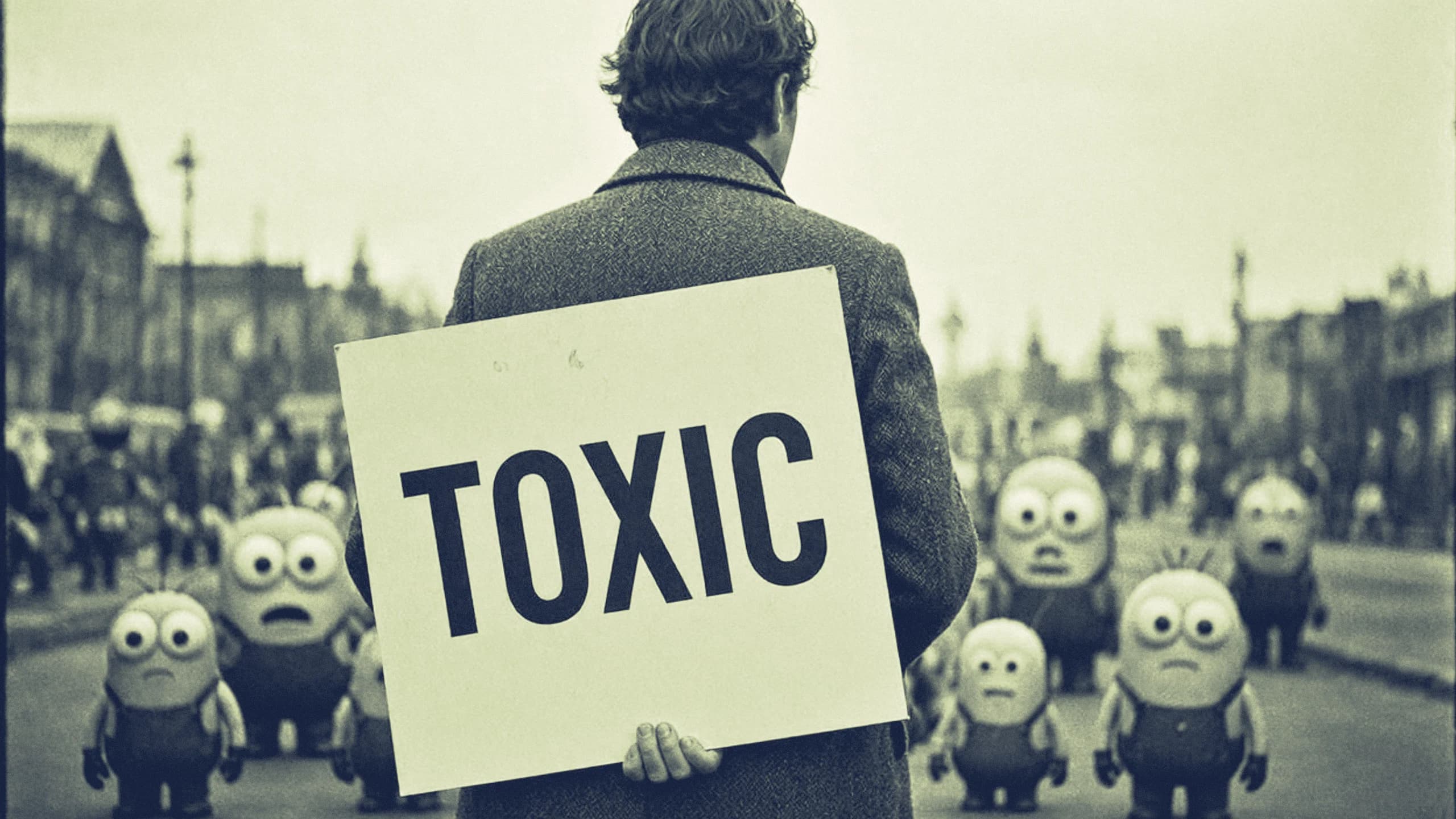
All of us sometimes like to suffer, to go through intense feelings and emotions.
It brings our psyche back to life. But every psyche has a limit to how much suffering it can take, and at some point it stops coping: intoxication sets in — and then trouble follows.
Toxic relationships are very dangerous, and almost everyone has been in one at least once. But what is toxicity, what is its nature, and why does psychology still have no such concept or definition? Let’s try to work it out.
In this article there is no need to wander into the thickets of the unconscious or the terminology of depth psychoanalysis. I have published an article for fellow psychologists in the academic journal of HSE University (in Russian), where I describe the whole process of the psyche’s intoxication more scientifically — through projection, transference and projective identification. Here I will only give a definition and an example.
Toxicity is an unconscious excessive reaction of one person’s psychological defences when they collide with another person’s defence mechanisms.
Studying the classics of depth psychology and my clients’ cases (relationships with toxic narcissists, for example), I arrived at the hypothesis that toxicity is always within us, and that it is always only a response to unbearable feelings that another person stirs up in us. Every relationship is toxic to some degree, but the toxicity shows not in everyday contact but in moments of crisis. We can be friends with someone for years and then one day block them on social media and messaging apps and cut them out of our lives entirely. Something like an affective outburst happens — it may be triggered by a specific situation or build up over time.
You can see in more detail how the mechanism of the psyche’s intoxication works in the video at the end of the article — excerpts from a meeting with colleagues at HSE University. I won’t publish the full recording, because it includes cases of clients who were victims of toxic relationships (personal stories are best published with the client’s permission and without details that could identify them). But one case I can tell here, with permission. It is about total lies, manipulation and toxicity.
In one session we came back to my client’s last relationship. Her ex had called her two days earlier. It was already evening. When she picked up, he said he was standing on a rooftop and that if she didn’t come back to him right now, he would jump — and it would all be her fault.
My client said that in that moment she felt intense shock, fear and resentment. She imagined standing on the roof beside him, holding hands. To stop him from jumping, in her fantasy she jumped instead of him. She even described the faint scent of his cologne that she had noticed so strongly when they first met. They talked on the phone for more than two hours. She even managed to message his friends and ask them to go to the address to save him.
It was night; his friends replied the next morning, saying that he had been out of town for a couple of days, at a country house with friends and his new girlfriend. My client didn’t believe it, and for two days now she had been trying to reach him — and although he shows up online, he doesn’t answer her calls or reply to the messages he has read.
Her toxic relationship lasted more than a year. She fled from it to Europe. But he won’t let go of her: like a leech, he can drain her energy even from thousands of kilometres away.
Such is the nature of toxicity and toxic relationships.
My advice is this: you don’t have to put up with a toxic relationship. If you think that in time you can change the character of, say, a toxic narcissist, I assure you it is impossible. Such a relationship will always cause you pain. How ready you are for that is for you alone to decide.
A lecture and seminar on the nature of toxicity (in Russian).
Psychologist, MSc in Psychology · 7 years in practice
Editor-in-Chief of PSY.one.