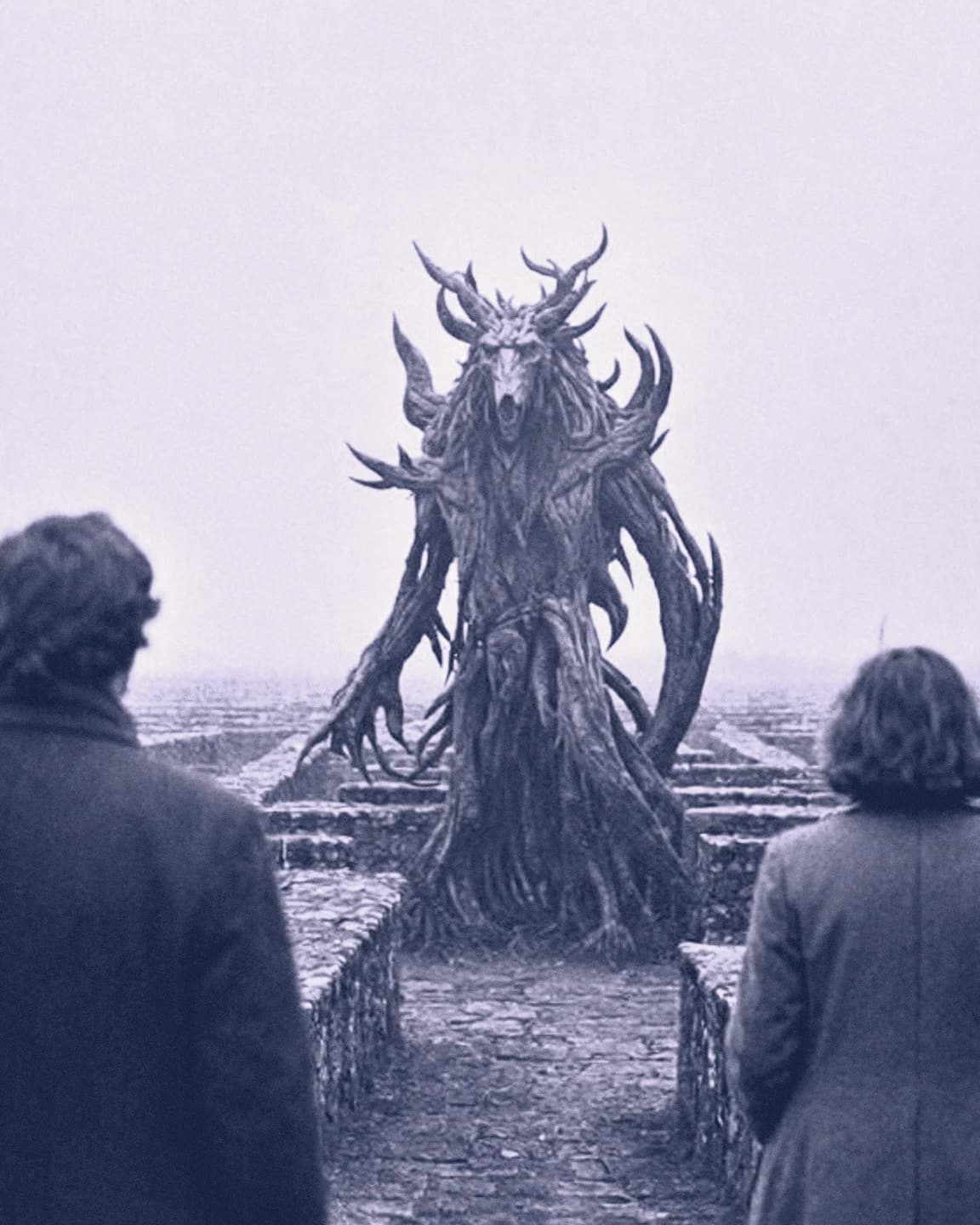



Magical thinking: fortune tellers, psychics, horoscopes and tarot.
What is magical thinking in a modern person?
Running late for an important meeting, you stare at the second hand of your watch, trying to stop time — or at least slow it down. You open your horoscope and, reading about Mercury in retrograde, try to explain your bad mood, quarrels and failures at work by the position of the stars. After watching a TV psychic contest, you go to a fortune teller to sketch the outline of your future and start to feel an illusory calm that everything will be fine. Yes — you get rid of the main source of anxiety: the fear of uncertainty.
Religion, like magical thinking, is about overcoming the fear of uncertainty. Why does everything happen this way? Because God willed it. Guilt and responsibility are shifted. It wasn’t me — it was God!
Magical thinking.
Any uncertainty in our lives strongly irritates the nervous system. It is uncertainty that makes us worry, get nervous and imagine the very worst futures.
Your child isn’t answering the phone! So they’ve been in an accident! No — they’ve been hit by a car! What’s worse? They’ve been attacked by a maniac and dismembered, and you’ll never find them or be able to say goodbye. You must ring round every police station — though the hospitals would be better — but the surest thing is to call every morgue at once and book a place in the cemetery. This is how our psyche works; this is how our defences work. Of course nothing has happened to your child. They just stayed late with friends and their phone ran out of battery. But you have already managed to imagine the worst. And all these fantasies come from childhood.
A baby is hungry, its mother has gone; it cries and screams, trying to attract attention, then fantasises that its mother has come back and it will be fed again — but she doesn’t come. The baby starts to scream frantically, loud enough for the whole street to hear. And then the fantasy arises that its mother will never come! It won’t get the breast, it will stay hungry, it will die!
At this moment the image forms in the child’s fantasies that it is the ruler of the universe — it is all-powerful. This is when magical thinking is born. Magical thinking as a way of protecting the psyche from every possible external and internal threat:
It is magical thinking that, in adulthood, lets us live through a huge number of stressful situations.
It is magical thinking that makes us go to church and light a candle for the dead or for someone’s health; it is magical thinking that makes us read horoscopes.
It is because of magical thinking that people hang little icons in their cars.
It is what gives us faith in folk omens and amulets.
The human psyche works selectively! It always tries to deceive consciousness and defeat the uncertainty around us. Nothing is more frightening than uncertainty. It is uncertainty that makes us imagine the worst possible outcomes.
The divine, aliens, the voice of the ancestors, amulets and charms, spells and the evil eye. Imagined reality offers a fantasy of personal omnipotence. That is why it is more attractive to the psyche than true reality.
Aliens: why does our psyche invent them?
There is an answer to all our questions. When we try in some way to classify and template ourselves and our problems, we speak of ourselves in the third person and describe our own personality by a pattern: say, as a hysteroid prone to sociopathy and a Scorpio born in the Year of the Rat. This is our psyche trying to cope with anxiety about an uncertain future and to explain all our problems in the most primitive way. But it is all pure nonsense — just the psyche deceiving itself in its struggle with the fear of uncertainty.
According to Freud, magical thinking is the belief that one can influence reality through symbolic mental or physical acts or thoughts. In his 1913 work “Totem and Taboo: Resemblances between the Mental Lives of Savages and Neurotics” (Russian edition), Freud applies psychoanalysis in an attempt to clarify unresolved problems of the psychology of peoples. In the book he describes in detail the ancient notion of “taboo” and compares the taboo prohibition with conscience and with certain external and internal rules whose violation will lead to inevitable catastrophic consequences, including death.
Here is a quotation from the chapter “Animism, Magic and the Omnipotence of Thoughts”: “To sum up, then: the principle governing magic, the technique of the animistic mode of thinking, is the principle of the ‘omnipotence of thoughts’. I have adopted the term ‘omnipotence of thoughts’
from a highly intelligent man who suffered from obsessional ideas and who, after being set right by psychoanalytic treatment, was able to give evidence of his efficiency and good sense. He had coined the phrase as an explanation of all the strange and uncanny events by which he, like others afflicted with the same illness, seemed to be pursued. If he thought of someone, he would be sure to meet that very person, as though by magic. If he inquired suddenly after the health of an acquaintance whom he had not seen for a long time, he would hear that he had just died, so that it would look as though a telepathic message had arrived from him. If, without any really serious intention, he swore at some stranger, he might be sure that the man would die soon afterwards, so that he would feel responsible for his death.
Freud links magical thinking with children’s fantasies of omnipotence. In modern psychiatry, magical thinking is considered normal in children under three to five and in members of what Freud called “primitive” cultures.
Magical thinking is common in schizophrenia-spectrum disorders. Modern psychiatry classes manifestations of magical thinking as adjustment disorders when a person starts visiting sorcerers, astrologers and psychics and building their life on their recommendations, or ends up in a cult.
Yet for some reason modern psychiatry and psychology on the whole don’t treat magical thinking as one of the psyche’s basic defence systems! I studied several dozen scientific papers on how magical thinking works. They mostly classify the behaviour of neurotics, psychotics and hysteroids caught in the trap of magical thinking. I began to think about how magical thinking helps us in everyday life. And the conclusion is fairly simple: magical thinking lets us live through severe stress and loss without serious damage to the psyche. Above all, it helps us defeat the fear of uncertainty by replacing true reality with an imagined one.
Every person is unique. Even identical twins have different psyches, different tasks in life and different experiences. They were born in the same year, month, day and hour. Their horoscopes are identical, but practice shows that each has their own path and their own story.
If magical thinking, performing its primitive but very important function of psychological defence, tells you that the coming year will be “not great” because you were born in June 1998 — that is pure illusion.
Our psyche believes in predictions, horoscopes, spells and the evil eye for one purpose only: to reduce as much as possible the uncertainty that frustrates us and narrow down the possible futures. Yes, it is our psyche, trying to protect us, that programmes the future from the options on offer. After all, it is simpler that way, clearer, there is someone’s higher will behind it — it is predestined by fate or karma.
But once you understand that this is not reality but the games our psyche plays to shield us from the unbearable wait for an unpredictable future, everything falls into place. Each of us is unique; we make plans for life (or for death), we try to imagine our future, but what really lies ahead we don’t know. And it is in this uncertainty of the future that the greatest happiness lies — the happiness of our one-of-a-kind destiny!
The magic of psychology.
Not everyone is ready to face their own uniqueness — their own grief, stress, pain, the unbearableness of life, and especially their own individual happiness. But some are.
The main thing is not to fall into the trap of magical thinking and to use it only where it fits. You need to tell reality apart from fantasies of your own omnipotence. In the fight against the fear of an uncertain future, making plans is very effective. Yes — ordinary plans for the day, the month, the year, for life. You don’t have to follow the plan, but it serves a very important psychological function: it grounds our uncertainty and reduces our fear of the unknown future as much as possible. Taking responsibility for your own future, reducing your fear of uncertainty and making plans for your life is a very important skill that lets you live your own life.
Psychologist, MSc in Psychology · 7 years in practice
Editor-in-Chief of PSY.one.