

In this piece we look at a cruel experiment in the search for love — one that plunged the scientist behind it into depression and pushed him into alcoholism.
The secret of love.
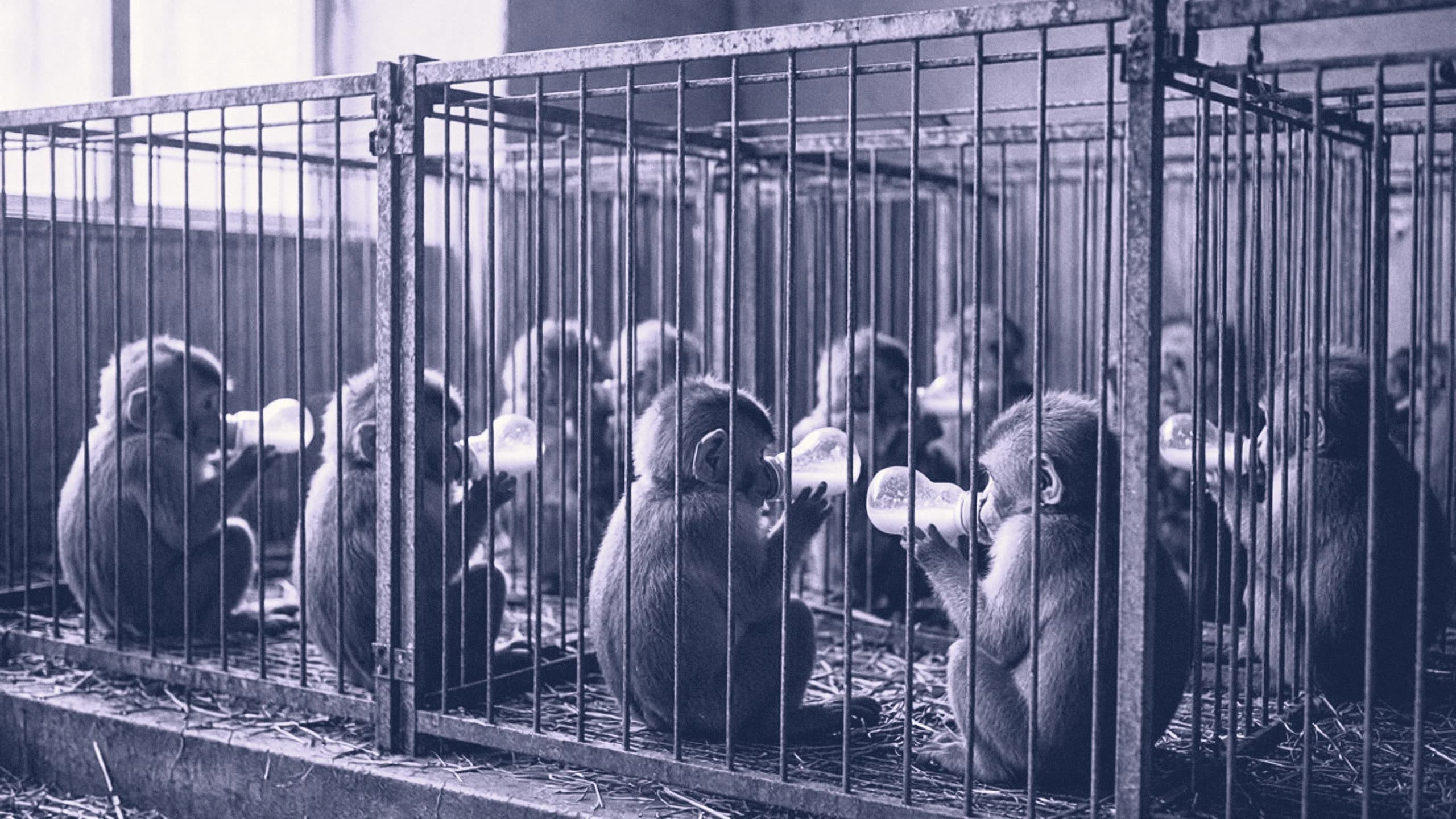
In the 1950s the American psychologist Harry Harlow experimented on rhesus macaques. He separated infant monkeys from their mothers and from their peers. In one experiment Harlow placed a newborn in a cage with two surrogate mothers made of welded wire — rather unappealing metal dummies of monkeys. One wire figure had a bottle of monkey milk fitted into it; the other was wrapped in a terry towel. The results were astonishing. The infant spent almost all its time with the towel-covered surrogate, hugging it, touching it, pressing itself against it.
It went to the cold wire mother only when it was hungry — after all, only she had the bottle of milk. After a while the infant was placed in an unfamiliar setting.
If the wire mother with the milk was in the room, the little macaque was terribly stressed: it trembled and huddled in a corner. If the “terry-cloth mother” was there, the infant behaved quite differently. Harlow was triumphant; he believed he had solved “the problem of love” and that a cloth mother could perfectly well replace a real one. But his triumph did not last long.
Harlow’s experiment.
Female macaques were firmly restrained in a position that allowed ordinary males, raised by living mothers, to mate with them by force. Twenty infants were born from these experiments. Their fate was grim. Most of the mothers killed their young, some showed no interest in them at all, and only a small share of the experimental females showed any maternal care.
It seems to me that such a brutal experiment shows the weight of severe psychological trauma (in this case imprinting, which I will write about in other chapters) as a trace of psychological defences left in our very DNA. The macaques deprived of their mothers in infancy completely rewrote their code and were incapable of natural relationships or of copying the habits and behaviour of their own kind.
From the first moments of life, the mother is the main means by which a child processes psychological distress. This function is complex, but it can be explained quite simply. In its earliest stages, an infant’s psyche is its mother’s psyche. And the child develops through what is called projective identification — it tries to control its mother.
Hunger, cold, light that is too bright, loneliness — all of this makes an infant uncomfortable. It is most striking when it comes to the need to be fed. A baby may fuss, cry and become hysterical. And we need to understand that it cannot keep demanding forever. When frustration lasts too long, because there is no way to satisfy its needs, the child’s nervous system burns out and the child shuts down. After prolonged stress, still without what it needed, it falls quiet and goes to sleep. That is the only way to get through a little longer.
The mother’s role is not only to feed the child, but also to let it use her psyche to live through strong emotions. If the mother is depressed, detached or emotionally cold, the child is left alone with its anxiety. Then we get an early negative experience of living through feelings. The infant’s psyche slows its development, and such traumas will unconsciously affect the person for the rest of their life.
The nature of love.
An excerpt from Timur Valeev’s talk at the “Practices and Development” festival (in Russian)
Psychologist, MSc in Psychology · 7 years in practice
Editor-in-Chief of PSY.one.