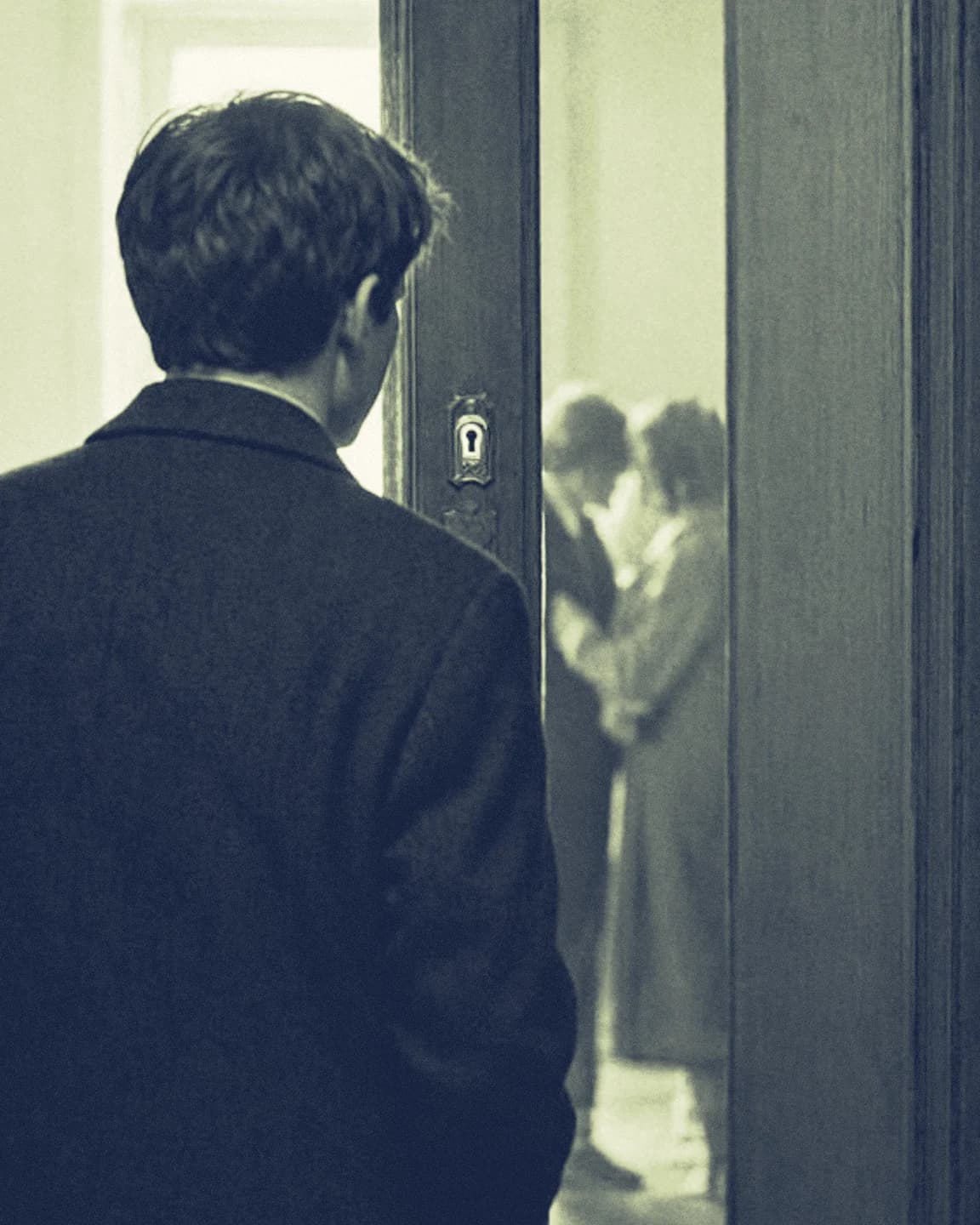


Jealousy can be a response to a real breach of what you agreed, an echo of past experience or a familiar script of love learned from family and books. Let’s work out how to tell one from another, find where your own jealousy comes from and get your freedom of choice back — even when anxiety fills every pause.
Jealousy is not a diagnosis
Jealousy can be an understandable reaction to a real threat to the relationship. Or it can be a constant expectation of betrayal, an attempt to control a partner, or an intrusive thought the person is tired of themselves. These often overlap. So what matters is not so much how strong the feeling is as what sets it off, which thoughts follow and what you do next.
Types of jealousy
Researchers describe reactive, anxious and possessive jealousy as different, though overlapping, forms (Barelds and Dijkstra, 2006).
Reactive: a response to something real
It appears in response to a specific act: a broken agreement, flirting, infidelity — anything your couple sees as a threat. What matters here is getting clear on the facts: what exactly happened, which boundaries were crossed and whether trust can be restored. If there really was a betrayal, the task is not to forbid yourself to feel jealous but to decide how to live with the consequences.
Anxious: “what if”
It arises in uncertainty. You expect betrayal and catch every tone of voice, every delay, every change in behaviour. A neutral event quickly gathers anxious guesses: imagination fills in what never happened.
Research links this kind of jealousy to insecurity about yourself and the relationship, and to anxious or avoidant attachment. It helps to take the chain apart: what I noticed → what I assumed → what I was afraid of → what I did out of fear.
Possessive: control
It shows in actions: limiting a partner’s contacts, demanding reports, checking their phone, forbidding them to see certain people. Behind it there may be fear of loss, a belief that love means ownership, a past betrayal or strong anxiety. But an explanation does not justify control. In therapy the work is both with the anxiety and with the beliefs — and with an honest look at responsibility for the restrictions and the boundaries crossed.
Jealousy of a partner’s past
It is aimed at what happened before you. You compare yourself again and again with your loved one’s former partners, ask for details and look for proof that you are better and matter more. Behind this there is often a fear of not being important enough and an attempt to gain complete certainty where it cannot be had. It helps to understand what exactly torments you: a specific piece of information, the image of a “rival” or the thought “someone else could be chosen over me”.
Obsessive jealousy
Repeated suspicions that torment the person who has them. You know you may be wrong, yet you check again, ask again, look for reassurance — so that it feels better for a little while.
In a survey of 1,076 adults, obsessive jealousy was linked to difficulties in everyday life and to verbal conflict in the couple (Ahlen et al., 2023).
When to see a psychiatrist: Othello syndrome
In delusional jealousy the belief in infidelity becomes fixed and is almost impossible to question, even without any evidence. This is a reason to see a psychiatrist: such a state can be linked not only to mental disorders but also to neurological conditions, medication or substances. A systematic review of 73 clinical cases of Othello syndrome describes a range of possible causes and stresses the need for a professional assessment. One episode of jealousy is not enough to draw such a conclusion (Park et al., 2024).
Where jealousy comes from
For some people jealousy is an almost constant background: to them, loving means knowing everything about a partner, right down to their thoughts and fantasies, and waiting for a catch. For others it flares up in response to a specific change in a partner’s behaviour. The flare passes, but if it keeps coming back, it gradually turns into a lasting feeling.
Jealousy is shaped by:
Personal experience — infidelity, rejection or a sudden break-up you have lived through.
Attachment — how safe closeness feels, whether you can trust and bear being apart for a while.
The family script — what a child saw at home: secrets, affairs, threats to leave, children being drawn into adults’ conflicts. Such a script is passed on through learned ways of building and talking about relationships, but this does not mean jealousy is inherited as an inevitable trait.
Health — sometimes strong jealousy is linked to a mental or medical condition. It matters how long ago the symptoms appeared, whether they came on suddenly and how you feel in general.
Jealousy from books and films
Another source is the romantic stories you grew up with. If in them jealousy and betrayal carry a romantic glow, while control, fighting for a partner and painful reconciliations look like proof of great love, that plot can become an inner yardstick. Later you do not necessarily repeat what you read on purpose, but you expect the same intensity from love: to worry, to fear losing, to win someone over, to get back together again.
How to stop being jealous: what helps in therapy
Work with jealousy starts with specific episodes: what happened, what thought came up, what you felt and how you tried to calm down. Then, step by step, you learn to:
tell a fact from a guess;
notice the story your imagination is drawing;
recognise the urge to text, check or get reassurance right away — and not give in to it at once;
tolerate uncertainty;
talk about boundaries without control.
In the pause you learn to stay with yourself: to watch the anxiety and choose your next step once it eases. Gradually an inner support appears: “I can miss you, be afraid, wait for clarity — and still live, relying on myself and on what we have really agreed.”
Five questions to understand your jealousy
What exactly sets it off?
What am I afraid of at that moment?
Where do these feelings live in my body?
What facts do I have, and what am I filling in?
What do I do to calm down — and does it help for long?
The answers will show what there is to work with: a real breach of agreements, old experience, anxious expectation, or behaviour that already limits another person’s freedom.
Works mentioned in this article
- Barelds, D. P. H., & Dijkstra, P. (2006). Reactive, anxious and possessive forms of jealousy and their relation to relationship quality among heterosexuals and homosexuals. Journal of Homosexuality, 51(3), 183–198. (Three forms of jealousy — reactive, anxious and possessive — and how they relate to relationship quality.)
- Ahlen, J., et al. (2023). Obsessional jealousy in a community sample: Association with relationship factors, impairment and perceived treatment needs. British Journal of Clinical Psychology, 62(1), 298–311. (A survey of 1,076 adults on obsessive jealousy.)
- Park, J., et al. (2024). Clinical characterization, course, and treatment of Othello syndrome: A case series and systematic review. Journal of the Academy of Consultation-Liaison Psychiatry, 65, 89–105. (A review of 73 clinical cases of Othello syndrome: causes and treatment.)
Psychologist, MSc in Psychology (HSE University), clinical psychologist, psychodrama therapist, executive coach · 15 years in practice
My working principle is to match the method to the specific request and lead towards real, positive change.